Rapid Revenue Growth Can Kill your Cash Flow (Strategies to avoid this)
Imagine landing the largest client contract in your company’s history. You celebrate with your team, update your revenue projections, and prepare for record-breaking growth.
Then, three weeks later, you sit down with your bank account open on one monitor and payroll software on the other, wondering how you are going to cover salaries on Friday.
If this scenario sounds familiar, you are not alone. It is one of the most counterintuitive traps in business: Rapid revenue growth can deplete your cash reserves, pushing a profitable company into a cash flow crisis.
Understanding why growth consumes cash—and how to fix the gap—is essential for every founder scaling a business.
The Growth Paradox: Why Increasing Revenue キ Increasing Cash Flow
The root cause of the "growth trap" lies in a fundamental accounting reality: Your Income Statement measures profit based on accrual accounting, as required by Generally Accepted Accounting Principles (GAAP). Under accrual accounting, revenue is recognized when earned, and expenses are recorded when incurred. However, your bank balance reflects actual cash received and disbursed, which rarely aligns with accrual accounting.
For example, when you complete a sale to a customer, extending 30 days credit, the revenues are recorded in the income statement as they are earned. However, no equivalent sales deposit is recorded to your bank account. On the other hand, inventory and labor costs are incurred to deliver the goods & services that are sold. These costs typically need to be paid before you collect from your credit customers. This creates a cash conversion gap.
When your business grows at 10% year-over-year, your existing working capital can usually absorb the gap between spending money and getting paid. But when growth accelerates to 30%, 50%, or 100%+, the cash required to deliver on that level of business has to be covered by high interest rate bank loans or lines of credit. If the business does not have access to these facilities, the company becomes cash strapped.
The 3 Drivers of the "Growth Trap"
1. The Working Capital Lag
To deliver a larger volume of sales, you must spend money upfront:
Services & SaaS businesses: You hire engineers, account managers, or support staff before or during the engagement.
E-Commerce & Manufacturing businesses: You purchase raw materials and inventory months before sale and collection.
If you pay your vendors and employees every 14 to 30 days, but your clients pay on Net-30 or Net-60 terms, rapid growth multiplies the amount of cash trapped in Accounts Receivable (AR).
2. Capacity & Overhead Scaling Costs
Growth often requires significant upfront increases in fixed overhead:
Upgrading software enterprise tier licenses.
Adding management layer roles ahead of further team expansion.
Moving to larger office space or warehouse facilities.
These additional cash outlays occur before the incremental revenue matures into cash collections.
3. Inventory Accumulation
For product-based companies, inventory can be a cash sinkhole. To hit higher growth targets, you must hold more inventory to maintain fulfillment standards. That inventory represents cash sitting on a warehouse shelf rather than in your bank account.
4 Red Flags Your Business is Falling into the Growth Trap
How do you know if your company is falling into the growth trap? Look out for these key financial indicators:
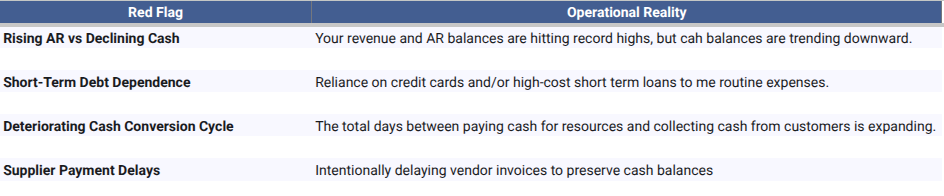
Red Flags of the Growth Trap
Strategic Solutions: How Strategic Financial Planning Fixes the Gap
Fixing cash flow bottlenecks does not mean slowing down your growth; it means actively managing working capital so growth pays for itself.
1. Implement a 13-Week Rolling Cash Flow Forecast
An income statement tells you where you were last month; a 13-week rolling cash flow forecast shows you where your bank balance will be in 90 days.
By modeling expected cash collections and operational disbursements week-by-week, you can spot cash troughs 4 to 6 weeks before they happen—giving you time to adjust payment terms, delay discretionary spend, or draw on a credit line proactively.
2. Optimize Your Cash Conversion Cycle (CCC)
Your Cash Conversion Cycle measures the time it takes to convert investments in inventory and resources into cash from sales.
CCC=Days Inventory Outstanding (DIO)+Days Sales Outstanding (DSO)−Days Payable Outstanding (DPO)
To shrink your CCC and free up working capital:
Lower DSO: Offer small discounts for early payments, require upfront deposits for larger projects, and automate billing follow-ups.
Extend DPO: Negotiate longer payment terms (e.g., from Net-30 to Net-45) with key suppliers as your order volumes increase.
Optimize DIO: Maintain lean inventory levels using just-in-time reordering models.
3. Secure Growth Capital Before You Need It
The worst time to ask a bank or investor for financing is when you are two weeks away from missing payroll. Establish a working capital line of credit while your financial statements show strong performance and liquidity, using it strategically to fund working capital gaps during surge periods.
Take Control of Your Working Capital
Growing revenue is a major accomplishment, but cash flow is what ensures your business survives to see the rewards. By shifting focus from pure top-line revenue to proactive cash flow management, you can scale sustainably without cash-flow stress.
Need Strategic Financial Clarity for Your Growing Business?
If rapid growth is straining your bank account, you don't need to navigate it alone. W.A. Anderson CPA provides forward-looking financial management, 13-week cash forecasting, and working capital optimization strategies without the cost of a full-time executive salary.
Schedule a Working Capital Diagnostic today👇 to identify trapped cash and map out a sustainable strategy for your next growth phase.
www.waandersoncpa.com/contact